Case Study • Operations Research
An automated workforce optimizer that uses constraint programming to schedule a 35-person healthcare support operation, reliably generating monthly rosters with zero violations and no unfilled slots.
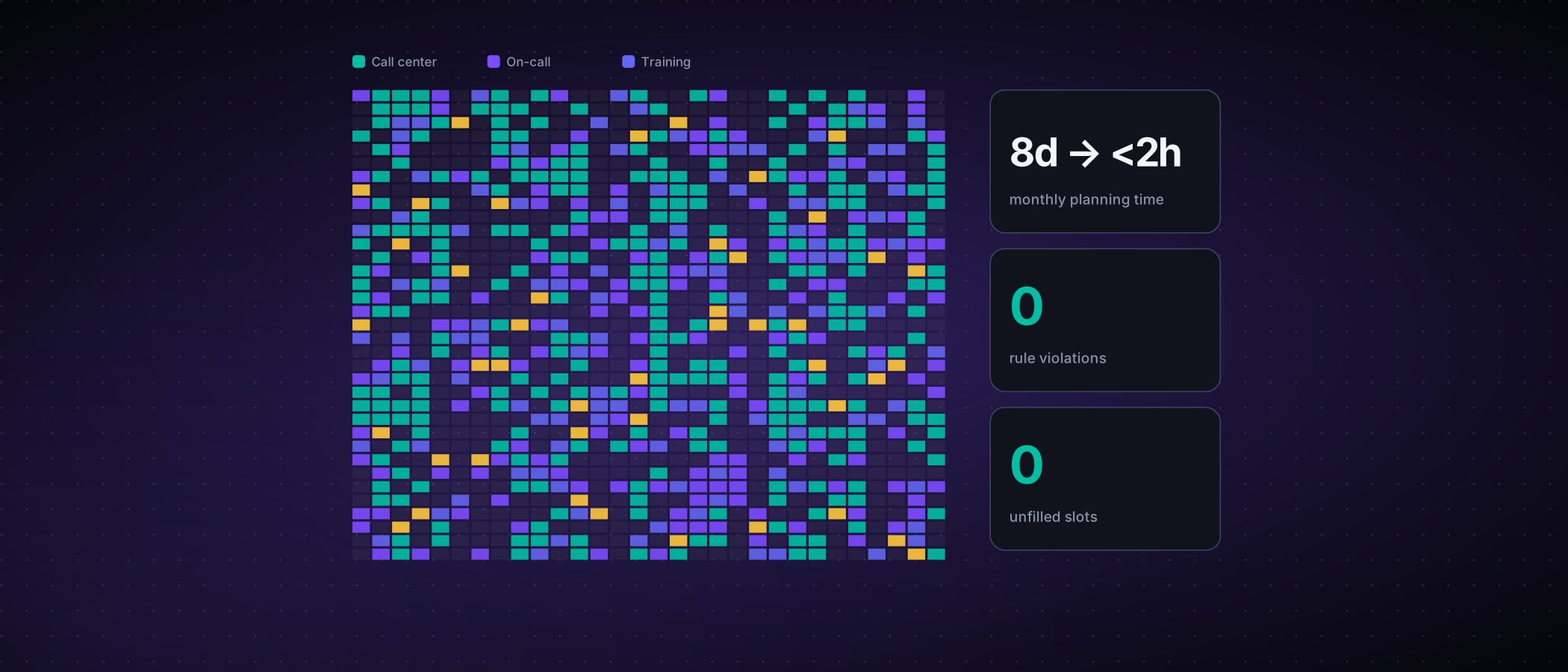
Every month, a manager rebuilt on-call, training-center and call-center coverage by hand, juggling shift rules, calendars, leave and fairness. It could take up to 8 days, and the result was still hard to defend.
The first version used a greedy heuristic, and in tightly constrained months it simply couldn't reach a fully valid schedule. That pushed the project to a global optimizer that treats the month as a single problem.
If a rule matters, it belongs in the model, and its violations belong in a report.
Every rule is explicit, every solution is checked and managers never have to touch the solver.
Hard rules are constraints, and fairness is balanced in the objective across the whole month.
Each solved roster passes through separate validators, so correctness doesn't rest on the solver.
Managers fill a dropdown-driven Excel form and get back a color-coded view of the schedule.
The whole chain is reproducible and audited for each scheduling run.
Rules managers care about rank above every optimization goal, without making a hard month infeasible.
Balance across people is an explicit objective rather than something a planner tries to remember.
Rule changes from management flow through a written register, tests and a repeatable run.
