
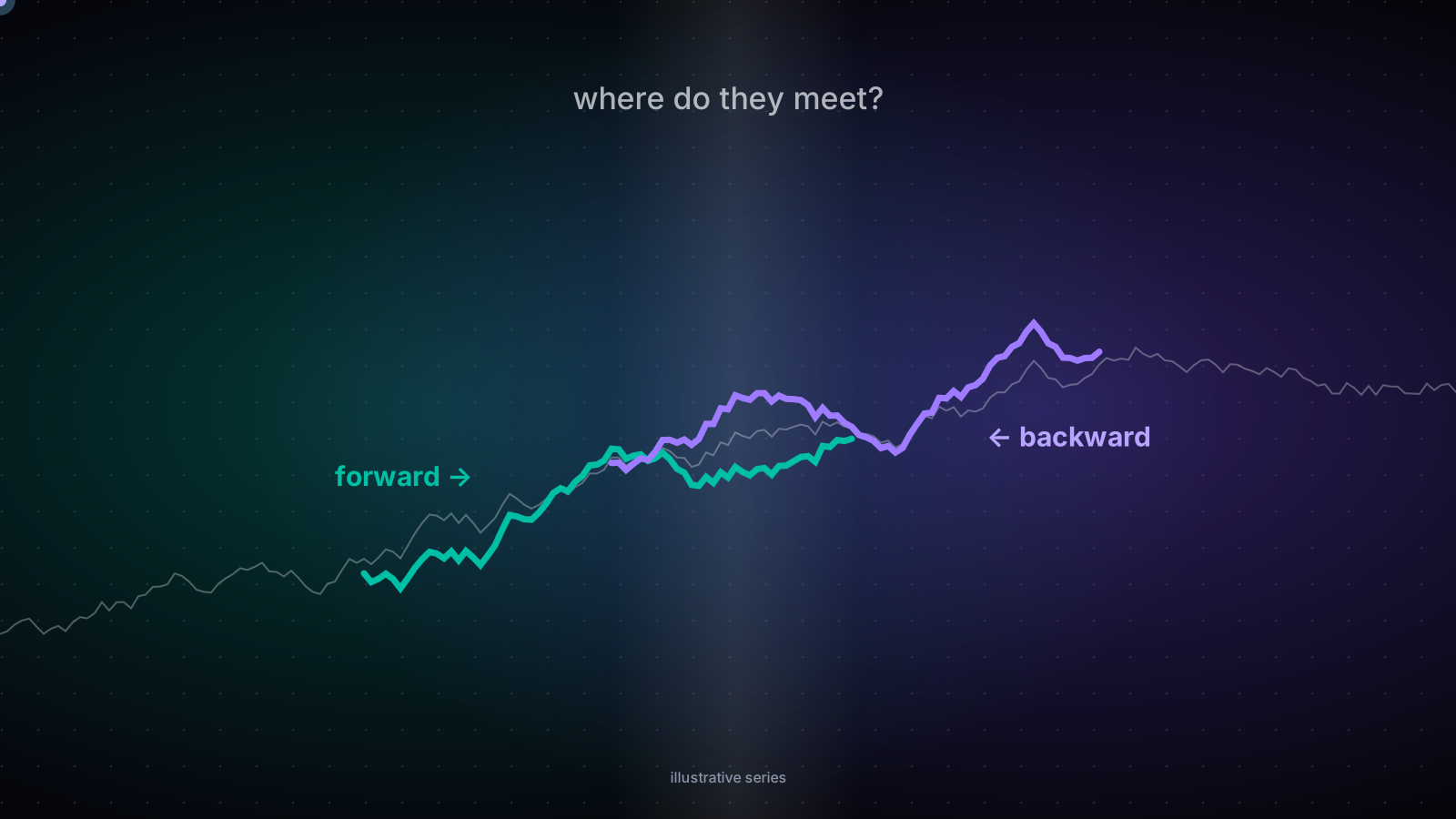
Most forecasting models only look one way: past to future. Hindcasting flips the direction and trains a model to predict earlier values from later ones. This work started at Sharif under Dr. Peyvandi, and it's heading toward a paper on whether the two directions can be fused into something better than either alone.
I'm using daily gold prices from 2010 to 2024 as the testbed, because the test window sits at all-time highs and punishes any model that quietly assumes the future looks like the past. It raises a few questions.
- Does backward information carry signal a forward model misses?
- Where do tree models hold up against deep models once you stop leaking?
- What's a fair comparison when protocols differ between models?
The first phase sets the forward baselines: XGBoost predicting one-day log returns, Prophet with expanding-window refits, and LSTM and iTransformer using per-window instance normalisation. Every experiment saves through one results registry, tagged by direction, so the final benchmark compares whatever exists without special cases.
The rules of the experiment.
Baselines before ideas.
One registry for every result.
Protocol differences get reported, not hidden.
The backward and hybrid phases come next, and there are no results to claim yet. When there are, they'll be here.